
Quick Summary
High yield toner is worth it when your printer runs steadily, because a high-yield cartridge costs more upfront but often lowers the cost per page. Light users who print only occasionally may find the standard cartridge cheaper, since a high-yield one can sit unused. Divide each cartridge's price by its rated page yield to find the break-even point for your own printing.
- Divide cartridge price by rated page yield to compare cost per page fairly.
- In the worked example, the high-yield cartridge breaks even at about 3,846 pages.
- Print coverage lowers real yield, so test one cartridge on your own workload.
- Confirm the exact printer model and part number before buying any cartridge.
- Choose original, compatible or remanufactured based on how much a print outage would cost.
Table of Contents
- What High Yield Toner Actually Means
- High-Yield vs Standard Toner Cartridges: Price and Page Count Side by Side
- Toner Cartridge Cost Per Page: Working Out the Real Number
- How Print Coverage Changes the Yield You Actually Get
- Printer Toner Cartridge Compatibility and Firmware Limits
- How Long Does a Toner Cartridge Last in Real Use?
- Original, Remanufactured and Compatible High-Yield Options Compared
- Deciding Whether to Buy High Yield for Your Printing
- Frequently Asked Questions
What High Yield Toner Actually Means
Last Updated: November 1, 2026
The question of whether high yield toner is worth the money comes up constantly with printer owners. A high-yield toner cartridge holds more toner than a standard one, so it prints more pages before it runs out. That is the core difference, and it is the reason the price is higher.
The catch is that "high yield" has no single fixed meaning. Each manufacturer rates its cartridges under its own test conditions, so a 3,000-page rating on one brand is not automatically comparable to a 3,000-page rating on another. Always check the printed page yield on the box and the part number, because the part number tells you the exact cartridge model.
The Ricoh SP311HE Original Toner Cartridge, for example, is sold as a high-yield unit for Ricoh SP series printers.
Watch out: the yield printed on a box assumes a typical page with light coverage. Heavy graphics and dense black areas will use far more toner per page than the rating assumes.
High-Yield vs Standard Toner Cartridges: Price and Page Count Side by Side
A high-yield cartridge costs more upfront than a standard cartridge for the same printer. The real question is whether the lower cost per page makes up for the higher purchase price. For a light user who prints a few hundred pages a month, the standard cartridge is often the cheaper choice because the high-yield one may sit on a shelf for a long time before it empties.
For a busy office, the math usually moves the other way. Fewer replacements mean fewer trips to the cupboard, fewer interruptions in the middle of a print run, and less time spent on purchasing paperwork.
Here is how the two options compare at a glance:
| Factor | Standard-Yield Cartridge | High-Yield Cartridge |
|---|---|---|
| Upfront price | Lower | Higher |
| Pages per cartridge | Fewer | More |
| Replacement frequency | Higher | Lower |
| Best for | Light, occasional printing | Steady, higher-volume printing |
| Cost per page | Often higher for heavy users | Often lower for heavy users |
Prices are quoted in LBP, so compare the figure on the cartridge you are considering against what you pay today per page.
Toner Cartridge Cost Per Page: Working Out the Real Number
Cost per page is the only number that lets you compare a standard cartridge and a high-yield cartridge fairly, because it folds the sticker price and the page yield into a single figure. The formula is simple: divide the cartridge price in LBP by its rated page yield. The result is what each printed page costs you in toner.
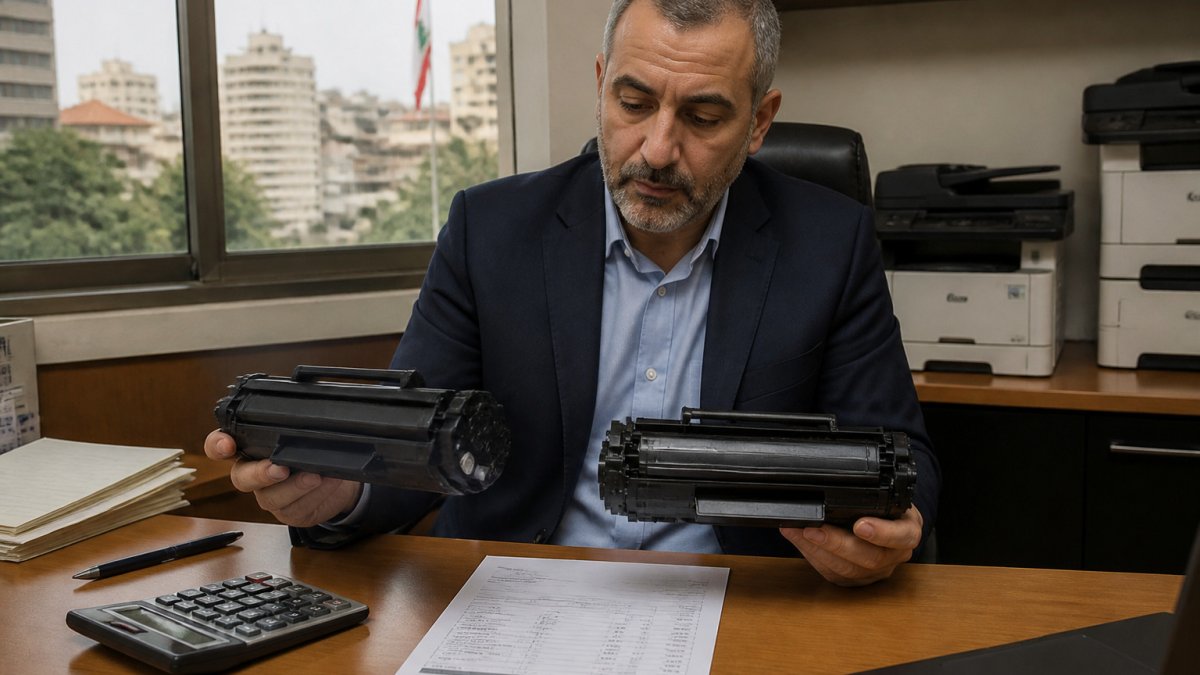
Here is a worked example using two cartridges for the same printer family. Suppose a standard cartridge is priced at LBP 90 and rated for 1,500 pages, while the high-yield version of the same cartridge is priced at LBP 140 and rated for 3,000 pages.
- Standard: LBP 90 ÷ 1,500 pages = LBP 0.06 per page
- High yield: LBP 140 ÷ 3,000 pages = LBP 0.047 per page
The high-yield cartridge costs LBP 50 more upfront, but it saves roughly LBP 0.013 per page. To find the break-even point, divide the extra upfront cost by the per-page saving: LBP 50 ÷ LBP 0.013 ≈ 3,846 pages. Once you print past that point, the high-yield cartridge is cheaper overall. Below it, the standard cartridge wins.
That break-even figure is the number to carry into the shop. If you print 500 pages a month, you reach break-even in roughly eight months. If you print 2,000 pages a month, you reach it in under two months. If you print 100 pages a month, the high-yield cartridge may never pay back before it sits long enough to become a storage concern.
Keep the calculation honest by using your own printing pattern rather than the box yield. A cartridge rated at 3,000 pages under light-coverage test conditions may produce far fewer pages if your documents are full of solid black areas, charts or forms. A separate guide on How To Calculate Printing Cost Per Page walks through a fuller calculation that includes paper and maintenance costs.
How Print Coverage Changes the Yield You Actually Get
Print coverage is the share of the page covered by toner. A page of plain text might cover five percent of the sheet, while a page with a photo or a solid colour band can cover far more. Heavy coverage uses toner faster, so the number of pages you get from a cartridge falls.
This matters because the advertised yield is measured under standard conditions. If your office prints marketing material, charts or dense forms, expect fewer pages per cartridge than the box suggests. Lighter coverage, such as mostly text documents and emails, gets closer to the rated figure.
Practical tip: test a single cartridge on your real workload for a month, count the pages, and use that number instead of the box figure when you calculate cost per page.
Ricoh SP311HE Original Toner Cartridge – High Yield →
Printer Toner Cartridge Compatibility and Firmware Limits
Compatibility is where most high-yield purchases go wrong, because printer families often share a name while taking different toner. A Ricoh SP 310 series machine and a Ricoh SP 311 series machine look similar and sit in the same product line, but the high-yield cartridge that fits one may not fit the other.
The reliable way to verify compatibility is to work from the printer's exact model number, not the marketing name. The model number is usually printed on a label on the back or underside of the printer, and it appears in the printer's settings menu under device information. Match that number against the cartridge's listed compatibility, and match the cartridge part number against the one printed on your current cartridge. If both match, the fit is almost certain.
Firmware is the second layer. Some printers can reject cartridges that are not on the manufacturer's approved list, and a firmware update pushed to the printer can change what it accepts after you have already bought supplies. Original cartridges avoid most of these problems because they are on the approved list by definition. Compatible and remanufactured cartridges vary in how reliably they work across printer generations, and a cartridge that worked on an older firmware version may be rejected after an update.
If you are unsure whether a cartridge will fit, send us your printer model and the part number on your current cartridge before ordering. Contact us on WhatsApp to confirm compatibility before ordering.
How Long Does a Toner Cartridge Last in Real Use?
A toner cartridge lasts as long as its toner lasts, and that depends on how you print. Several factors shorten its life: heavy graphics, printing in draft mode less often than you think, frequent start-stop jobs, and printing in a hot or humid room.
For low-volume offices, a cartridge can last many months. For busy print rooms, the same cartridge may need replacing in a matter of weeks. Storage also matters. Keep unused cartridges in their sealed boxes, away from direct sunlight and heat, until you need them.
Watch out: a cartridge can show "low toner" before it is actually empty. Shaking it gently can extend its life slightly, but do not wait until print quality is clearly poor, or the drum may wear faster.
Original, Remanufactured and Compatible High-Yield Options Compared
Three types of high-yield cartridge are common in Lebanon, and each suits a different buyer:
- Original cartridges come from the printer maker. They offer the most predictable fit and output, and they suit businesses where print quality and reliability matter most. Our Ricoh MC2000H Original Toner Cartridge is one example, listed at LBP 90.
- Compatible cartridges are made by third parties to fit a specific printer. Our ION TN3437 Brother Compatible Toner, listed at LBP 25, is an example. They are often priced lower, so check the fit and the printer's warranty terms before you buy.
- Remanufactured cartridges are used shells refilled with new toner.
Choose based on how much a failed print or printer repair would cost you. For a critical business printer, the original cartridge is usually the safer bet. For a secondary printer used lightly, a compatible option can make sense.
For a closer look at checking authenticity before you buy, read How To Verify Original Printer Cartridges. If you are weighing cheaper options in the local market, How to Find Cheap Ink Cartridges in Lebanon covers where to look and what to check.
Deciding Whether to Buy High Yield for Your Printing
High-yield toner is worth the money when your printer runs steadily, your cost per page is lower than the standard option, and you want fewer replacements. It is less worthwhile if you print only occasionally, because a cartridge can sit unused and dry out.
Use this checklist before you buy:
- Confirm the exact part number for your printer model.
- Estimate your monthly page count honestly.
- Calculate cost per page for both high-yield and standard options.
- Decide how much a print outage would cost you.
- Choose original, compatible or remanufactured based on that risk.
If your numbers point to high yield, the Ricoh SP311HE Original Toner Cartridge - High Yield is a solid choice for Ricoh SP series printers. Need help checking which cartridge suits your printer? Get in touch with Dabbous Mega Supplies and we will help you choose.

Frequently Asked Questions
Are high-yield toner cartridges worth the extra cost?
For printers that run a steady volume of pages each month, usually yes. A high-yield cartridge costs more upfront but spreads that price across far more pages, so the cost per page often drops. Dabbous Mega Supplies sells the Ricoh SP311HE High Yield original toner from LBP 140 and the Brother TN3437 original toner from LBP 165, so you can compare the price per page against the cheaper standard option before deciding. Light, occasional printing rarely justifies the premium.
How do I compare the cost per page of standard and high-yield toner?
Divide the cartridge price by its rated page yield. Use the yield printed on the box, not a guess, and remember that real pages depend on coverage. If a standard cartridge costs LBP 90 for 1,500 pages and a high-yield one costs LBP 165 for 3,000 pages, the standard option works out to LBP 60 per 1,000 pages and the high-yield option to LBP 55 per 1,000 pages. Check the yield figure for your exact model before you buy.
Can I use a high-yield toner cartridge in my printer?
Only if the cartridge is listed for your exact model. Printers in the same series often use different part numbers, so match the part number rather than the printer name. The product listings name compatible models, and you can contact Dabbous Mega Supplies on WhatsApp to confirm fit before ordering. Buying the wrong part number is the most common reason a new cartridge fails to print.
Are compatible high-yield toner cartridges reliable?
Compatible cartridges can be a sound low-cost choice, but quality varies between suppliers. Look for a seller that confirms compatibility for your printer. Dabbous Mega Supplies sells the ION Brother TN3437 compatible toner from LBP 25 alongside the original Brother model at LBP 165, so you can test a compatible cartridge on a lower-stakes job first.


