

Last Updated: November 7, 2026
Quick Summary
Sensitive business documents should be destroyed by cross-cut shredding, either with an in-house office shredder or a professional service that gives a certificate of destruction. Regular bins and hand tearing leave readable data that can be recovered by anyone who digs through the waste.
- Cross-cut shredding is the minimum for files with customer, financial or ID data.
- Hand tearing is unsafe because torn strips can be reassembled.
- Sort papers by retention status before shredding, and remove staples and clips first.
- Keep a destruction log with dates, document types, method and the names of who authorised and witnessed it.
- Put a legal hold process in place so routine shredding never destroys records under dispute.
Table of Contents
- Why Sensitive Business Documents Cannot Go in the Regular Trash
- Documents Businesses Should Shred
- Step-by-Step: How to Prepare Documents for Disposal
- Confidential Document Disposal Methods Compared
- Choosing a Method by Security Level, Volume and Budget
- Building a Business Document Retention and Destruction Policy
- Handling Digital Files and Storage Devices Too
- Setting Up Your Disposal Routine This Week
- Frequently Asked Questions
Why Sensitive Business Documents Cannot Go in the Regular Trash
Sensitive business documents hold more than ink on paper. They carry customer names, bank details, payroll records, tax files and contracts.
In Lebanon, many small offices still throw out old invoices and staff files in ordinary rubbish bags. That habit is risky.
Shredding and proper collection stop most of the risk before it starts.
Here is what usually goes wrong:
- Rubbish bins are open to anyone. Cleaners, delivery staff and passers-by can reach them.
- Whole pages stay readable. A single unshredded sheet can still show a name, account number or signature.
- Recycling is not a shield. Paper bound for recycling can be sorted and read before pulping.
Watch out: taping torn strips back together is a common shortcut.
Documents Businesses Should Shred
Not every piece of paper needs shredding. Focus on anything that could harm a customer, employee or the business if someone else read it.
Common documents to destroy include:
- Customer records: names, addresses, phone numbers and order histories
- Financial papers: bank statements, cheques, invoices and receipts with card details
- Payroll and HR files: salary slips, contracts, ID copies and performance reviews
Keep a simple rule: if it contains a personal identifier or a number someone could use to access money or accounts, shred it.
Step-by-Step: How to Prepare Documents for Disposal
Good preparation makes destruction faster and safer. Work through these steps before any paper leaves your office.
- Sort by retention status. Separate papers you must keep from those past their retention period. Check your own record-keeping duties before destroying anything.
- Remove staples, clips and binders. Most shredders handle these, but removing them protects the blades and speeds up the job. The SUNWOOD SD9511 handles staples and paper clips, but bulky binders still need separating.
- Trim bound or oversized pages. Use a paper trimmer to cut thick reports or A3 sheets into manageable sizes.
- Batch by volume. Stack papers in small piles rather than feeding one huge pile at once. Overloading causes jams.
- Store waiting papers securely. Keep the pile in a locked bin or cabinet until shredding day, not on an open desk.
- Log what you destroy. A short list of dates and document types helps with audits later.
Confidential Document Disposal Methods Compared
There are several ways to destroy paper. Each one suits a different level of risk, volume and budget. The useful question is not which method is "best" but which method fits your daily throughput, your staffing, and the sensitivity of the records you handle.
Most businesses use one of two main routes: shredding in-house or hiring a service. Hand tearing and burning are rarely good options for office records. The table below sums up the main choices.
| Method | Security Level | Best For | Typical Cost | Key Trade-off |
|---|---|---|---|---|
| In-house office shredder | Good to very high (depends on cut size) | Daily small volumes | Equipment cost plus power | You control timing and access, but staff time and blade wear are on you |
| Off-site shredding service | High, with certificate | Large or regular volumes | Priced per box or per visit | Cheaper per kilo at volume, but paper leaves your premises before destruction |
| On-site mobile shredding | Very high, witnessed | Sensitive bulk records | Higher, per visit | You watch the destruction, but you pay for the visit and must schedule around it |
| Hand tearing | Low | Almost nothing | Free but unsafe | Strips can be reassembled; not a defensible method for sensitive files |
In-House Shredding with an Office Shredder
An office shredder keeps documents under your own roof. You control access and timing, which suits daily work well.
Choose a model based on cut type and capacity. For higher daily volumes, the SUNWOOD SD9281 HEAVY DUTY SHREDDER is a commercial-grade choice, and the SUNWOOD SD9280D Shredder suits lighter office use.

Shred in short sessions, and empty the basket before it overflows. Most models stop automatically when full, so check the basket regularly.
Watch out: a strip-cut machine is cheaper upfront but leaves long readable ribbons. If the paper carries account numbers or ID copies, cross-cut is the minimum.
Professional and Off-Site Shredding Services
A shredding service collects your paper and destroys it elsewhere. This works well when volumes are too large for an office machine.
Ask providers how they transport and store paper before it is destroyed. Look for a written certificate of destruction for each collection.
A common pattern is to treat "professional shredding" as one undifferentiated option. It is not. Ask each provider:
- Chain of custody: Who holds the key to the collection bin, and who signs the paper over at pickup?
- Destruction point: Is the truck shredding on your site, or is the paper consolidated at a depot first?
- Certificate content: Does the certificate name the date, the volume, the method and the signatory, or is it a generic receipt?
If the answer to any of these is vague, the certificate is worth little as audit evidence.
Choosing Between In-House and Outsourced
Use these rules of thumb, then adjust for your own risk appetite:
- Under 10 pages a day: a small cross-cut office shredder is usually enough.
- Regular daily volumes: a heavy-duty commercial shredder pays for itself against per-visit service fees.
- Large monthly volumes or archived files: a shredding service with locked collection bins is more practical than staff time spent feeding a machine.
Budget matters, but do not cut corners on cut size. A cheap strip-cut machine saves money upfront and can leave files readable. Factor in staff time, blade replacement and storage of waiting paper, the equipment price alone understates the true cost of in-house shredding.
Choosing a Method by Security Level, Volume and Budget
Match the method to the risk. Low-risk papers such as old menus can go into standard recycling. Anything with customer or financial data needs cross-cut shredding at least.
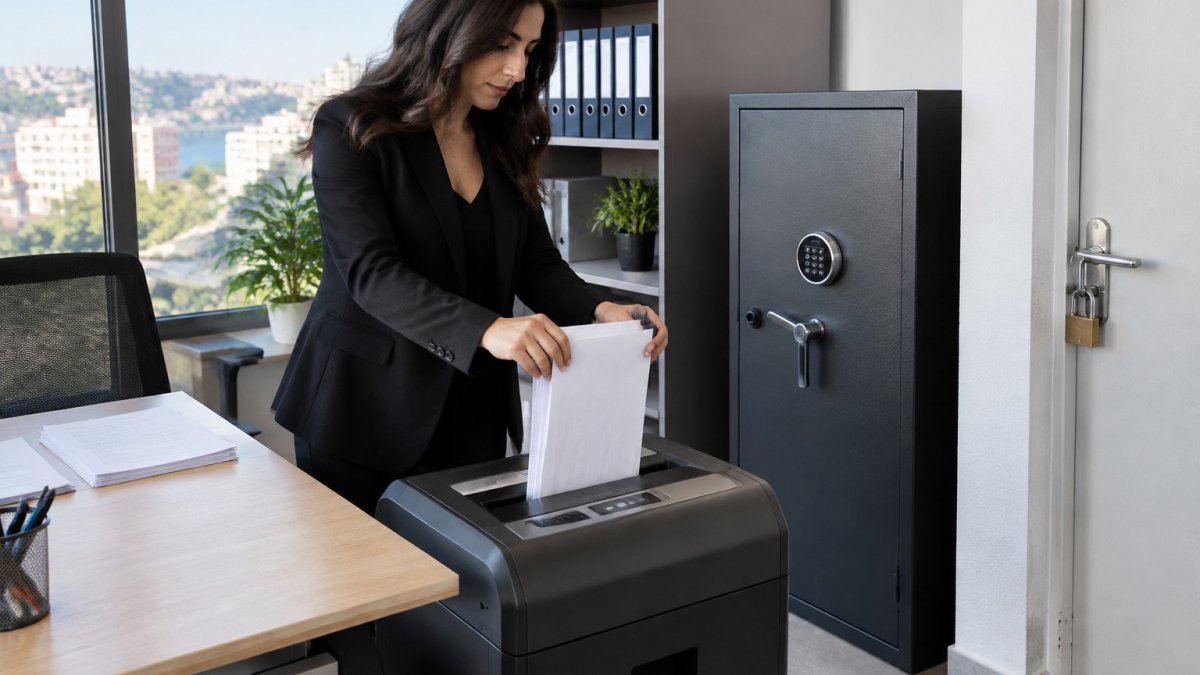
Use these rules of thumb:
- Under 10 pages a day: a small cross-cut office shredder
- Regular daily volumes: a heavy-duty commercial shredder
- Large monthly volumes or archived files: a shredding service with collection bins
Budget matters, but do not cut corners on cut size. A cheap strip-cut machine saves money upfront and can leave files readable.
Building a Business Document Retention and Destruction Policy
A written policy turns one-off clean-ups into a routine. It tells staff what to keep, what to shred and who approves it. The gap most guides leave is the mechanics: how to decide a retention period, how to freeze destruction when a dispute arises, and how to prove later that destruction happened when it should have.
Step 1: Build a Retention Schedule
List each document type your business holds and assign a retention period. Do not guess, base it on the rules that apply to your sector and on how long you may need the record to defend a claim. A common pattern is to group records into broad families:
- Statutory and tax records: keep for the period your tax authority can assess or audit.
- Employment records: keep for the period a former employee could bring a claim.
- Customer and contract records: keep for the contract term plus the limitation period for breach of contract.
Where the applicable rule is unclear, keep the record longer rather than shorter, and note the reasoning in the schedule.
Step 2: Apply Legal Holds
A legal hold suspends destruction for any record that may be relevant to a dispute, investigation or regulatory request. Without a hold process, a routine shred day can destroy evidence you are obliged to preserve.
A workable hold process has three parts:
- Trigger: who can declare a hold, and how they notify staff.
- Scope: which document types, date ranges and custodians are covered.
- Release: who confirms in writing that the hold is lifted before destruction resumes.
Watch out: a hold that lives only in one person's inbox is not a hold. Record it in the same log you use for destruction so the two cannot drift apart.
Step 3: Define Destruction Triggers and Authority
State clearly when a record moves from active storage to the shred pile, for example, at the end of the retention period, on closure of a matter, or on a scheduled annual review. Name one responsible person who signs off on each destruction batch. A second person should witness bulk destruction.
Step 4: Keep Proof of Destruction
A destruction log should record, for each batch:
- Date of destruction
- Document types and approximate volume
- Method used (in-house shredder, off-site service, on-site mobile)
Keep certificates and logs for at least as long as the records themselves would have been retained. If an auditor or regulator asks why a record no longer exists, the log is your answer.
Step 5: Review Annually
Check the policy each year against changes in your business, your sector rules and your storage volumes. Share it with every team member, and keep copies of destruction certificates on file.
Handling Digital Files and Storage Devices Too
Sensitive data also lives on hard drives, USB sticks, old laptops and cloud folders. Deleting a file does not remove it from the device.
For digital media, try these steps:
- Wipe drives before reuse or sale: use secure erase tools rather than a simple delete
- Physically destroy failed drives: drilling or crushing removes data that software cannot reach
- Clear printer and copier memory: many office machines store scanned copies internally
Keep the same logging habit for devices as you do for paper.
Setting Up Your Disposal Routine This Week
Start small and build the habit. You do not need a large budget to make a real difference.
This week, try these actions:
- Pull out one box of old files and sort it using the retention checklist
- Choose a shredder that fits your typical daily volume
- Set a fixed shred day, and lock the bin until then
- Write a one-page policy and share it with your team
Start with the riskiest papers first, and expand from there. A tidy, consistent routine protects your customers and your business far better than a one-time clean-up.
Ready to set up in-house shredding? Browse our shredders and get started today with Dabbous Mega Supplies.
Frequently Asked Questions
How should a business dispose of sensitive documents?
Sort papers by how sensitive they are, then destroy them rather than throwing them away. Cross-cut or micro-cut shredding is the safest in-house option because it leaves particles that cannot be reassembled. For large volumes, use a professional shredding service that collects the material, shreds it on or off site and gives you a certificate of destruction. Keep a record of what was destroyed and when, so your disposal can be audited later.
Is shredding the safest way to destroy confidential business papers?
For most businesses, yes. Shredding turns paper into pieces small enough that the information cannot be recovered in practice. Tearing by hand is quick but leaves readable fragments, so it is not suitable for confidential material. Burning or pulping is effective but often impractical in an office. Choose a shredder with a security level that matches your risk: strip-cut shredders suit low-risk papers, while cross-cut or micro-cut models suit financial, HR and customer records.
What business documents should never go in the regular trash?
Any document containing personal, financial or client information should be destroyed securely. This includes bank statements, payroll records, tax papers, contracts, employee files, customer details, medical information and ID copies. Even drafts, old invoices and printed reports can reveal more than you expect, so treat anything with names, account numbers or signatures as confidential. Keep confidential waste bins separate from general recycling.
Can sensitive documents be destroyed without a paper shredder?
Yes, but the method must be thorough. Cutting pages into small pieces with scissors or tearing them into quarters is better than nothing, though it is slow and rarely as secure as machine shredding. For a one-off batch, you can also use a professional service that picks up locked bins. Avoid leaving documents in open recycling or regular trash, because that is the most common route for information to leak.


