

Quick Summary
Security document shredding is the process of destroying paper records so their information cannot be read or rebuilt. Businesses should sort which papers carry risk, such as customer files, payroll records, and bank statements, then shred those with a cross-cut or micro-cut machine.
- Shred client files, payroll records, bank statements, contracts and passwords, but recycle plain marketing flyers and brochures.
- Cross-cut shredders are the safer choice for confidential material, while strip-cut machines are easier to piece together.
- Use a retention schedule and keep a destruction log so you can prove compliance during an audit.
- Keep a chain of custody record and request a certificate of destruction from any outside shredding provider.
- Check shredded output by hand and confirm the pieces are small enough for your security level.
Table of Contents
- Sorting Which Documents Need Secure Shredding
- Understanding Data Protection Regulations Before You Destroy Anything
- Choosing Between Cross-Cut vs Strip-Cut Shredders
- Setting Up an In-House Security Document Shredding Routine
- Managing Confidential Waste Management From Bin to Disposal
- Verifying Destruction and Scheduling Your Next Shred Run
- Choosing Your Shredder and Ordering Supplies From Dabbous Mega Supplies
- Frequently Asked Questions
7 Steps to Secure Document Shredding for Your Business
Last Updated: November 9, 2026
Sorting Which Documents Need Secure Shredding
The first mistake many offices make is shredding everything or nothing. For the broader guidance on disposing of sensitive business records safely, see how to dispose of sensitive business documents safely.
Start by listing the types of paper in your office. Some of it holds personal or financial details. Some of it does not. Sorting first saves time, money and shredder wear.
Records that always need destruction
Some papers should never go into a regular bin. Treat these as sensitive:
- Customer and client files with names, addresses or contact details
- Payroll and staff records including salaries and ID numbers
- Bank statements, invoices and tax papers
If a page could help someone impersonate your company or a client, it belongs in the secure pile.
Records you can safely recycle
Not every page is a risk. Plain marketing flyers, public brochures, old product catalogues and blank forms can usually go into standard paper recycling. Keep this pile separate so your secure shredding stays focused and affordable.
Understanding Data Protection Regulations Before You Destroy Anything
Before you shred, you need to know which rules apply to your records. Data protection regulations set expectations for how personal information is kept and disposed of.
A practical rule: keep records only as long as you need them, then destroy them securely. Many businesses set a retention schedule that lists how long each file type stays in the office and when it goes to shredding.
Building a retention schedule that works
Start by listing every record type your office creates or receives. For each, note the legal or operational reason to keep it and a destruction date. Common patterns include:
- Payroll and tax records: often kept for several years to meet tax authority requirements.
- Customer contracts: retained for the duration of the contract plus a period for potential disputes.
- Employee files: kept during employment and for a defined period after departure.
Assign one person to approve destruction dates and keep a simple log of what was destroyed and when. This log becomes your evidence of compliance if an audit occurs.
Sector-specific compliance checklists
Different industries have additional rules. Use these checklists as a starting point and verify with your legal advisor:
Healthcare providers:
- Patient records must be kept confidential and destroyed securely after the retention period.
- Consider using micro-cut shredders for any document containing medical details.
Financial services:
- Client financial data, account statements, and transaction records require secure destruction.
- Cross-cut or micro-cut shredders are recommended for all sensitive financial documents.
Legal practices:
- Case files and client correspondence must be destroyed in a way that preserves confidentiality.
- Maintain a chain of custody log for all destroyed documents.
General businesses:
- Any document with personal data (names, addresses, ID numbers) should be shredded.
- Train staff to recognize sensitive information and follow the retention schedule.
Watch out: Regulations can change, and penalties for improper disposal can be significant. Review your retention schedule annually and update it when laws change.
The role of a data protection officer
If your organization handles large volumes of personal data, consider appointing a data protection officer (DPO) or assigning responsibility to a senior staff member. This person oversees the retention schedule, approves destruction, and ensures staff training is up to date. Even a part-time role helps maintain accountability.
Documenting your compliance
Keep a simple compliance file that includes:
- Your retention schedule
- Destruction logs (date, record type, method, person responsible)
- Staff training records
This file demonstrates due diligence and can be invaluable during an audit or if a data breach is suspected.
Choosing Between Cross-Cut vs Strip-Cut Shredders
The cut style decides how hard a document is to put back together. Cross-cut shredders slice paper into small pieces in two directions, which makes reconstruction much harder. Strip-cut machines cut long thin strips, which is faster and cheaper but easier to piece together.
For confidential material, cross-cut is the safer choice. Strip-cut can work for low-risk recycling, but it is a weak option for client or payroll files.
Security levels and what they mean in practice
Security levels describe how small the final particles are. In everyday use, look for:
- Strip-cut: Low security, suitable for general office waste
- Cross-cut: Medium security, good for most business records
- Micro-cut: High security, for highly sensitive files
The Sunwood SD9511 is a heavy-duty cross-cut model that handles 15-17 sheets at a time and includes a security level 4 rating. You can find it in our range at SUNWOOD SD9511 Shredder. The Sunwood SD9281 is a commercial model designed for medium office use.

Pros of cross-cut shredders:
- Strong security for most business records
- Good balance of speed and cost
Cons of cross-cut shredders:
- Slower than strip-cut on large volumes
- Higher upfront price than basic strip models
Pros of strip-cut shredders:
- Lower purchase price
- Fast for large amounts of low-risk paper
Cons of strip-cut shredders:
- Easier to reconstruct sensitive pages
- Not suitable for confidential files
The article compares the main shredder cut styles and what each protects against.
| Cut style | Security level | Best for |
|---|---|---|
| Strip-cut | Low | General office waste |
| Cross-cut | Medium | Most business records |
| Micro-cut | High | Highly sensitive files |
Setting Up an In-House Security Document Shredding Routine
An in-house routine works best when it is simple. Put the shredder where staff can reach it without walking far, and keep a clearly labelled secure bin beside it.
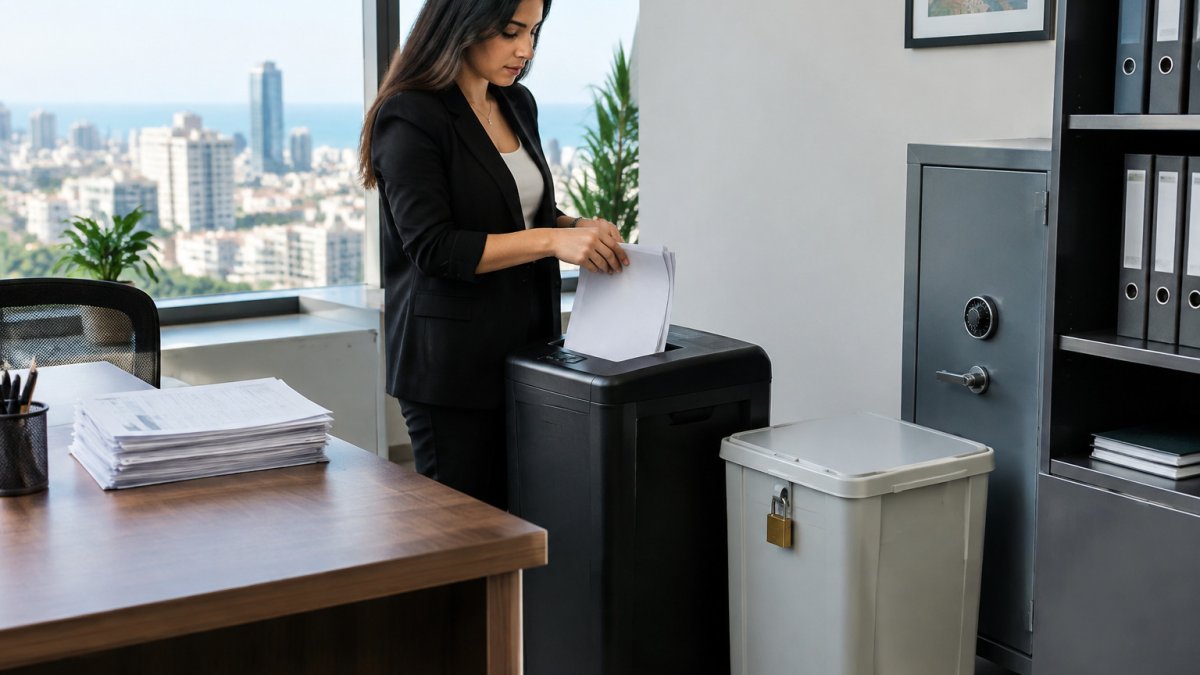
Pick one person to check the bins each week. Empty them on a set schedule so papers do not pile up in corners or on desks. A paper trimmer also helps prepare thick bundles before feeding them into the shredder, which protects the motor.
Set clear rules for staff:
- Shred confidential papers the same day they are no longer needed
- Never leave sensitive documents on printers or desks
- Feed no more than the rated sheet count at one time
Managing Confidential Waste Management From Bin to Disposal
Shredding is only one step. Confidential waste management covers what happens to the paper from the moment it leaves someone's desk until it is gone. Gaps in this chain are where information often leaks.
Secure containers and access control
Use locked bins for paper waste that has not yet been shredded, and limit keys to trusted staff. Browse our safes category for secure storage options that fit this access-control approach.
For higher volumes, consider a console or wheelie bin with a lock and a slot that prevents removal of documents. Position bins so they are visible but not accessible to visitors.
Chain of custody: the missing link in most offices
A chain of custody record shows who handled the papers, when and where. Even for in-house shredding, a simple log helps.
But a log is only as good as the process behind it. Follow these steps to maintain an unbroken chain:
- Collection: Staff place sensitive documents into locked bins. Only authorized personnel have keys.
- Transport: If bins are moved to a shredding area, log the time and the person responsible.
- Destruction: The person operating the shredder records the date, time, and volume destroyed.
- Verification: After shredding, a second person checks a sample of the output to confirm particle size meets your security level.
- Disposal: Shredded paper is bagged and sent for recycling. Record the date and method of disposal.
Watch out: If you use an outside shredding service, ensure they provide a certificate of destruction that includes the date, time, and a description of the materials destroyed. Without this, you have no proof the documents were actually destroyed.
Mobile vs. off-site shredding: which is right for you?
If you decide to outsource, you have two main options:
Mobile shredding, a truck equipped with a shredder comes to your location. You can witness the destruction, which provides strong assurance. This is ideal for businesses that want to see the process and avoid transporting documents.
Off-site shredding, your documents are collected in locked bins and taken to a secure facility for destruction. This is often more cost-effective for large volumes but requires trust in the provider's chain of custody.
Consider your risk tolerance and volume. For highly sensitive documents, mobile shredding may be worth the higher cost. For regular office paper, off-site can be sufficient if the provider is reputable.
Post-shredding verification: beyond the certificate
A certificate of destruction is a start, but you can add your own verification. For in-house shredding, periodically inspect the shredded output. Pick up a handful of pieces and confirm they are small enough for your security level.
For outsourced shredding, ask about the provider's verification process. Some offer video monitoring or allow you to witness the destruction. If not, consider a trial run with a small batch to assess their thoroughness.
Sustainability: closing the loop
Shredded paper can be recycled. Bag it separately and send it to a recycling facility. Many shredding services include recycling in their offering. This reduces environmental impact and supports your sustainability goals.
By managing the entire chain from bin to disposal, you protect your business and demonstrate a commitment to data security that clients and regulators appreciate.
Verifying Destruction and Scheduling Your Next Shred Run
Do not assume shredding worked just because the machine ran. After each run, check the output. Pick up a handful of shredded pieces and confirm they are small enough for your security level.
Then set the next shred date on the calendar. A monthly run suits most small offices, while busier teams may need weekly collection. Keep the date fixed so the process stays routine and nothing is forgotten in a cupboard.
Choosing Your Shredder and Ordering Supplies From Dabbous Mega Supplies
Choosing the right shredder comes down to your volume and your risk level.
At Dabbous Mega Supplies, we stock a range of Sunwood shredders for offices of different sizes. Browse the full selection on our Shredders page.
We deliver across Lebanon, with delivery typically taking 1-3 days and same-day options available. If you need help choosing the right model for your workload, our team is happy to advise.
Secure shredding protects your clients, your staff and your business. Pick the right machine, set a simple routine and keep your records secure from desk to disposal.
Frequently Asked Questions
Why is secure document shredding important for data privacy?
Discarded paper can be recovered from bins and recycling, and it often holds names, bank details, contracts and client records. Secure shredding turns those pages into fragments too small to reassemble, which limits identity theft and data leaks. For a business, it also protects customer trust and keeps you on the right side of data protection rules. A single unshredded invoice or payroll sheet can expose far more than its size suggests, so treat every confidential page as something that must be destroyed, not just thrown out.
What types of documents should be shredded for security?
Shred anything containing personal identifiers, financial information, client or patient records, employee files, contracts, payroll data, and internal strategy documents. Old drafts and handwritten notes with sensitive details belong in the shred pile too. Plain marketing flyers or published brochures can go to ordinary recycling. When unsure, ask whether the page would cause harm if a stranger read it, and if the answer is yes, shred it.
How does a cross-cut shredder differ from a strip-cut shredder for confidential waste?
A strip-cut shredder slices paper into long vertical strips, which is fast and inexpensive but leaves text readable if strips are reassembled. A cross-cut shredder cuts both ways, producing small particles that are far harder to piece together. For confidential records, cross-cut is the safer choice. The Sunwood SD9511 Heavy Duty Paper Shredder (LBP 330) and SD9281 (LBP 150) listed on Dabbous Mega Supplies offer cross-cut options.
How often should a business schedule secure document shredding?
Schedule shredding based on volume and how quickly confidential paper builds up. A busy office with daily client paperwork may need in-house shredding every day or two, while a small team might shred weekly. Set a fixed routine, use locked bins between collections, and never let confidential waste sit in open trays. Review the schedule every few months as your paperwork volume changes.


